Why buy a lab grown diamond engagement ring instead of a mined one?
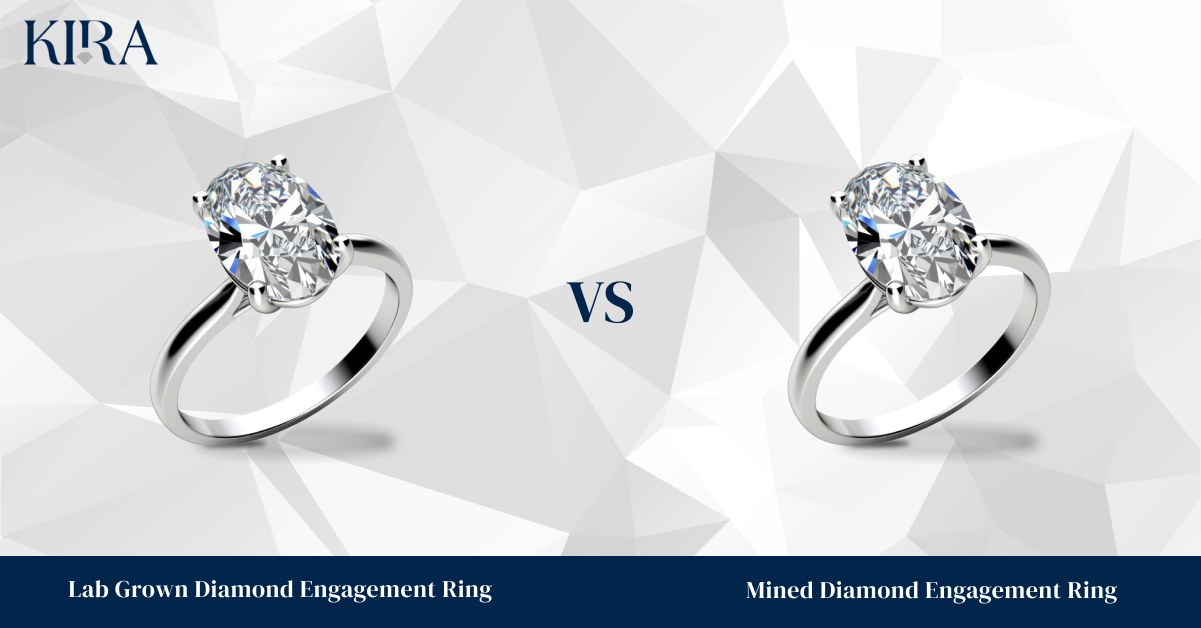
Demand for lab grown diamonds is rising rapidly, and retailers are in a prime position to serve this growing market. Modern buyers, especially those making meaningful purchases such as engagement rings, increasingly prioritise sustainability, ethical sourcing and cost-effectiveness. Lab grown diamonds tick all these boxes. For retailers, this is a valuable opportunity to align with shifting preferences.
At the front of this transformation is KIRA, the world's largest grower of CVD lab grown diamonds. With an advanced manufacturing facility in Surat, India, we deliver high-quality stones that are chemically and physically identical to mined diamonds. They come at a lower cost and let customers feel confident that a special piece reflects their commitment to sustainability and ethics.
Why lab grown diamond engagement rings
KIRA's partner Shanay Parekh sees strong potential in the Indian market, where demand keeps increasing. Although some retailers are hesitant to adopt lab grown diamonds, he believes that offering customers the choice between lab grown and mined stones will bring in a wider customer base without cannibalising mined stone sales.
Affordability without compromising quality
One of the most attractive reasons to choose a lab grown diamond for an engagement ring is the cost saving. They are typically 60 to 85% less expensive than mined stones, offering significant value without sacrificing beauty, quality or durability.
While a mined stone of similar carat size, clarity and cut might cost substantially more, a lab grown diamond lets you stretch your budget further. You can invest in a larger stone or add details such as a more intricate setting.
As KIRA chairman Vallabhbhai Patel has said, people who buy and wear diamonds would be 2 percent of the population, and with lab grown diamonds the potential is simply 100 percent of the population.
Key benefits of affordability:
- 60 to 85% cost saving, so couples get more for their money.
- The same quality as mined stones, being physically, chemically and optically identical.
- More budget flexibility, so you can opt for a larger stone or spend more on customisation and setting.
According to a report by Allied Market Research, the global lab grown diamond market is expected to reach $37.32 billion by 2032, growing at a compound annual growth rate of 9.6% from 2023 to 2032.
This surge is driven not only by affordability but also by growing awareness of the ethical and environmental advantages.
Environmentally friendly and sustainable
One of the biggest advantages is a significantly lower environmental impact. Traditional mining is known for its heavy toll on the environment, involving large-scale excavation, water pollution and extensive energy use. Lab grown diamonds have a much smaller carbon footprint.
Our solar plant in India helps us produce sustainable CVD stones across 700,000 square feet, producing over 7.2 million rough carats annually.
- Smaller carbon footprint. Creating these stones requires far less energy than mining, leading to a substantial reduction in greenhouse gas emissions.
- Reduced land disruption. Unlike mining, which removes vast amounts of earth, lab grown diamonds are produced in controlled environments, preserving ecosystems and wildlife habitats.
- Water conservation. Mining often involves contamination and depletion of local water supplies, while lab grown production uses significantly less water.
As our chairman puts it, lab grown diamonds are environment-friendly because there is no mining and no disturbance to nature.
Ethically produced
Lab grown diamonds come without the ethical concerns linked to traditional mining, such as conflict diamonds or poor labour conditions. While the Kimberley Process works to reduce these issues, mined stones still carry some ethical uncertainty.
Lab grown diamonds are produced in controlled environments, so they are conflict-free and ethically produced.
Key ethical benefits:
- Conflict-free, with no ties to conflict zones.
- Fair labour, since controlled production supports ethical working conditions.
- Buyer preference. Over 60% of buyers prefer ethically sourced stones (Global Witness, 2021).
Quality and durability
Lab grown diamonds are just as durable as mined stones, ranking 10 on the Mohs scale, so they withstand everyday wear.
Many are also classified as Type IIa, the purest type, offering exceptional clarity and brilliance. Only 1 to 2% of mined stones achieve this.
- Same hardness. They match mined stones in hardness and durability.
- Purity. Often Type IIa, with fewer impurities than most mined stones.
Lab grown diamonds and the future of the jewellery industry
Growing demand
Lab grown diamonds are surging in popularity, particularly among millennial and Gen Z buyers. According to the De Beers 2023 Diamond Insight Report, their share of the market jumped from 2% in 2019 to 8% in 2023. Younger generations are leading the change, prioritising sustainability, affordability and ethical sourcing.
Key trends:
- Rapid growth. Lab grown diamonds now represent 8% of the global market, up from 2% in 2019.
- Gen Z preference. 70% of Gen Z buyers prefer lab grown diamonds over mined stones.
- Driving sustainability. Younger generations are pushing for sustainable, ethically sourced jewellery.
Customisation and versatility
Lab grown diamonds offer greater flexibility for customisation thanks to their lower price point. This lets buyers opt for larger stones or higher-quality settings, making engagement rings more personal.
- More options. Lower prices allow bigger stones or more intricate designs.
- Tailored to your style. KIRA offers a wide range, customisable to any preference or budget.
Final thoughts
| Key benefit | Details |
|---|---|
| Cost-effectiveness | More affordable, allowing larger stones or more elaborate settings. |
| Sustainability | A smaller carbon footprint, making them an eco-friendly choice. |
| Ethical sourcing | Free of the ethical concerns of traditional mining and conflict-free. |
| Quality | Identical to mined stones in hardness, durability and beauty, often Type IIa. |
Conclusion
Lab grown diamonds are an innovative and responsible choice for modern couples who value sustainability, ethics and affordability. Choosing one is not just about a beautiful stone, it is a statement about the kind of future you want to build.
As the world's largest producer of lab grown diamonds, KIRA offers quality and selection that make it easier than ever to find the right engagement ring.
Looking for loose stones?
Discover KIRA Diam, the world's largest CVD lab grown diamond producer, offering 150,000+ certified stones from our state-of-the-art Surat facility. We specialise in fancy coloured stones in yellow, pink, blue and green, in shapes including round, oval, radiant, emerald, pear, princess and marquise. With over 7.2 million rough carats produced annually and reliable global delivery, we can fulfil orders of any size.