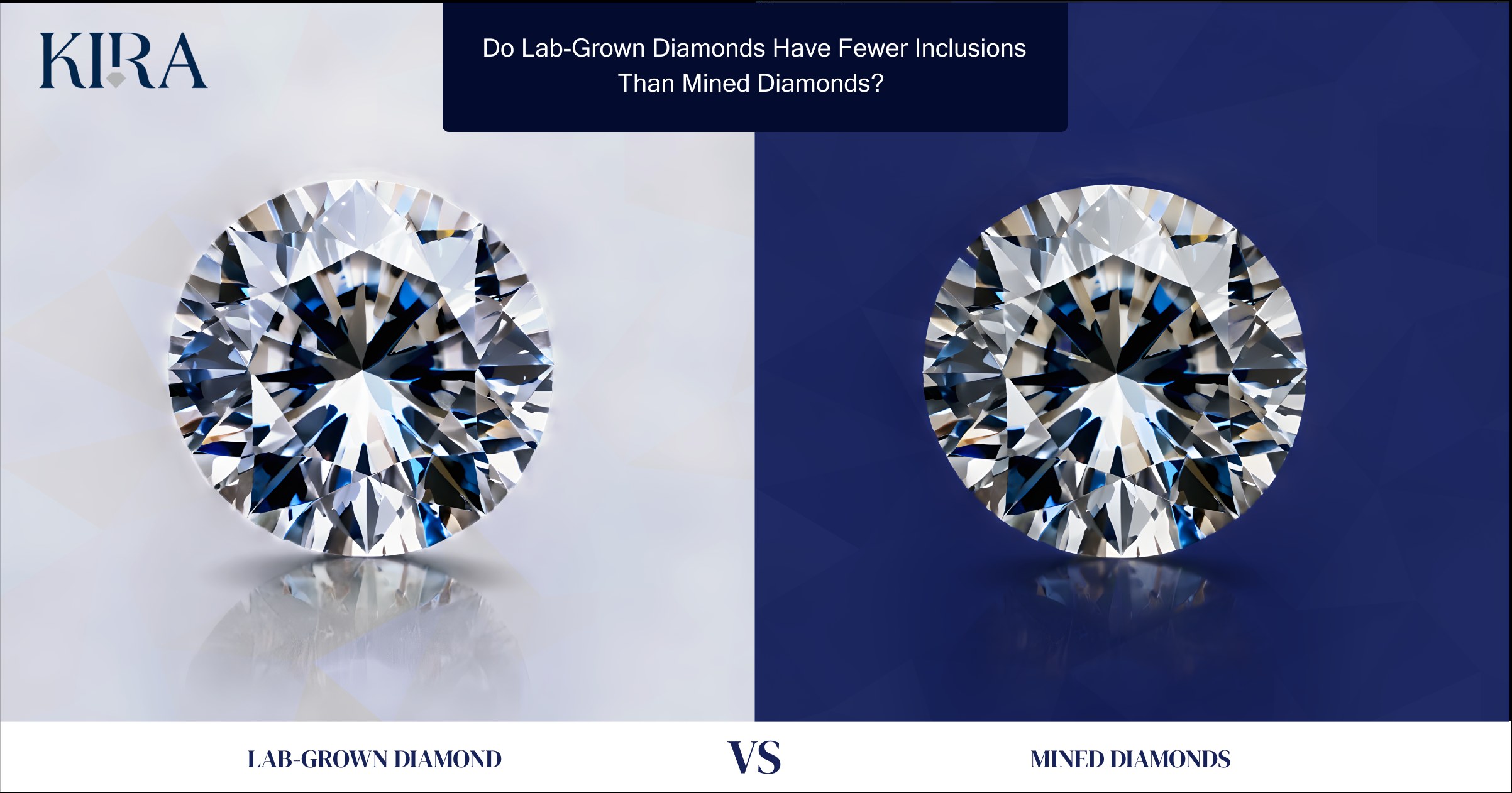
Do lab grown diamonds have fewer inclusions than mined diamonds?
What are inclusions?
Inclusions are imperfections inside a stone, formed during its growth. These internal flaws vary widely, appearing as tiny crystals, clouds or small fractures. They are the result of the pressure and heat a stone goes through as it forms. Inclusions essentially tell the story of a stone's creation, acting as a fingerprint of the conditions it experienced.
The more inclusions a stone has, the lower its clarity grade. Clarity is one of the four Cs used to assess overall quality, alongside cut, colour and carat weight. Inclusions can affect how light passes through the stone, reducing its brilliance. Larger inclusions can even be visible to the naked eye. Most, however, are microscopic and need magnification to detect, though their presence still affects value.
Both mined and lab grown stones show various types of inclusions. The most common are:
- Feathers. Tiny cracks or fractures inside the stone. Often hard to see without magnification, though larger feathers can affect durability.
- Pinpoints. Minute black or white dots, usually invisible without magnification.
- Clouds. A grouping of pinpoints that creates a hazy effect.
Inclusions form differently in mined and lab grown stones. Mined stones develop them because of uncontrollable conditions in the Earth's mantle over millions of years, while lab grown stones develop them during the controlled crystallisation process.
Do lab grown diamonds have inclusions?
Yes, lab grown diamonds have inclusions, just as mined stones do. These characteristics arise as the crystal forms, whether deep in the Earth or inside a controlled chamber.
The key difference is that lab grown diamonds usually show fewer inclusions than mined stones.
Fewer inclusions than mined stones
Because they are made in controlled environments, lab grown diamonds tend to carry fewer inclusions and higher clarity. Many reach VS clarity or better, and some, such as Type IIa material, are close to inclusion-free. That is rare in mined stones. Only 1% to 2% of all mined stones worldwide are certified as Type IIa, and such rarity carries a premium.
Scientific control
Lab grown diamonds benefit from advanced technology that controls the crystallisation process, reducing significant inclusions. Mined stones form over millions of years under unpredictable conditions, while lab grown diamonds are created in weeks or months with precise regulation. The result is often superior clarity.
Why lab grown diamonds tend to have fewer inclusions
Inclusions in mined stones form because of extreme, unpredictable conditions deep in the Earth's crust, including high temperature, pressure and surrounding minerals. Lab grown diamonds are made in controlled environments, which reduces the factors that cause inclusions.
Two main methods are used:
- HPHT (high pressure, high temperature). This mimics natural formation and can produce high-quality stones, but may introduce small metallic inclusions from the catalysts used.
- CVD (chemical vapour deposition). Stones grow layer by layer in a controlled gas mixture, giving fewer inclusions and higher purity.
Both methods have benefits, but CVD stones are known for exceptional clarity.
Differences in the types of inclusions
Mined stones contain a variety of inclusions such as mineral crystals, fractures and growth patterns, reflecting the random natural environment in which they form. These are often complex, and some contain trapped minerals.
Lab grown diamonds have fewer and simpler inclusions, often metallic or internal graining, because of the controlled growth process. This predictability results in higher clarity grades and fewer imperfections.
| No. | Characteristic | Lab grown diamonds | Mined diamonds |
|---|---|---|---|
| 1 | Inclusion types | Uniform, often metallic or internal graining | Varied, including mineral crystals and fractures |
| 2 | Complexity | Less complex, more predictable | More complex, formed randomly |
| 3 | Clarity grades | Higher clarity grades | Lower clarity grades on average |
| 4 | Formation process | Controlled, predictable environment | Unpredictable natural processes |
Clarity grading
Stones are graded on a clarity scale ranging from Flawless (FL) to Included (I). The fewer and less visible the inclusions, the higher the grade. Lab grown diamonds generally perform better in clarity grading than mined stones of similar size.
Grades are assigned based on the size, number and location of inclusions. Stones graded VS (very slightly included) or VVS (very, very slightly included) have inclusions that are difficult to spot even under 10x magnification.
The GIA clarity scale has 11 grades, from Flawless to Included. Most stones in stores fall between VS and SI. Flawless stones show no visible inclusions or blemishes, while I1, I2 and I3 stones have obvious inclusions that may affect brilliance and durability.
Lab grown diamonds not only offer higher clarity grades, they do so at a more affordable price. That allows buyers to purchase larger stones with fewer imperfections for less.
Myths about inclusions in lab grown diamonds
Myth 1: they are flawless
While lab grown diamonds often have fewer inclusions, they are not completely flawless. Like mined stones, they can still develop inclusions during growth. These are typically fewer and less visible, giving better overall clarity.
Myth 2: their inclusions are worse
Some believe lab grown diamonds have more visible or problematic inclusions than mined stones. This is generally untrue. Their inclusions tend to be smaller and more predictable, giving higher clarity grades overall.
How important are inclusions to buyers?
For many buyers, clarity is a top priority. It is worth noting that inclusions are not always visible to the naked eye, especially in higher clarity grades. A stone graded VS1, for example, has inclusions that are only visible under magnification.
While clarity matters, some buyers prioritise cut, colour and carat weight instead. Lab grown diamonds offer a good balance of high clarity and affordability.
Beyond clarity, lab grown diamonds are favoured by buyers who value environmental sustainability and ethical sourcing. Unlike mined stones, which are sometimes associated with harmful mining practices and conflict zones, lab grown diamonds provide a conflict-free, eco-friendly option.
Conclusion
Inclusions are a key factor in clarity for both mined and lab grown stones. Lab grown diamonds generally have fewer of them because of their controlled creation process, offering higher clarity grades at a more affordable price.
For buyers looking for ethical and sustainable options, KIRA is the world's largest lab grown diamond grower and a one-stop solution, with environmentally responsible practices throughout.