CVD vs HPHT: which is the better lab grown diamond process?
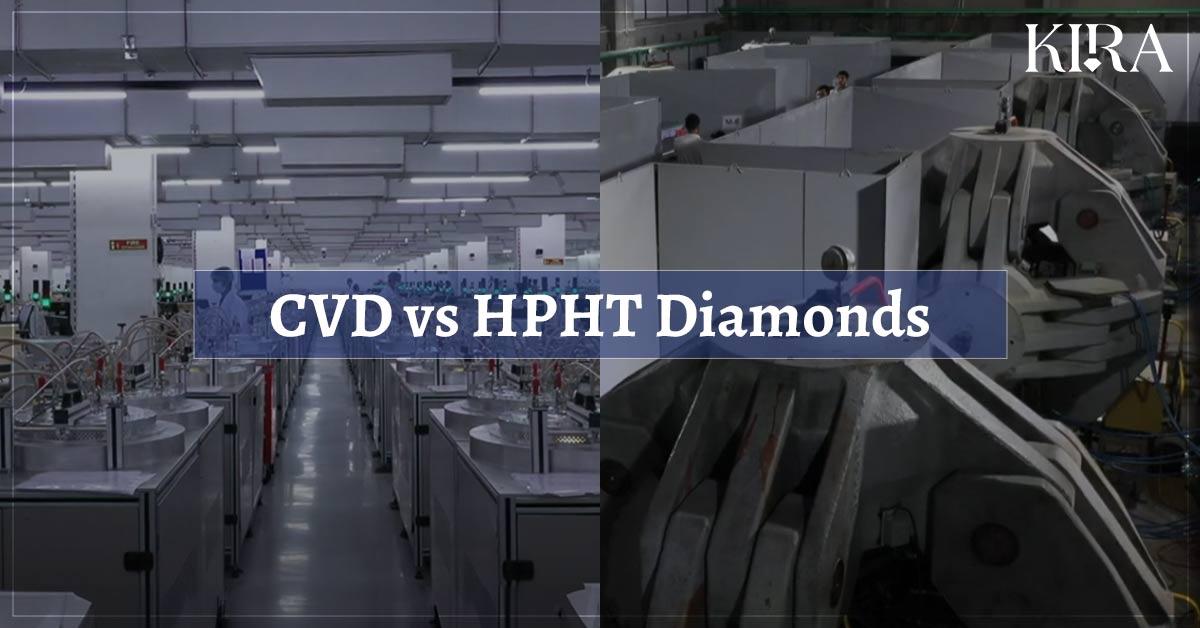
According to a report by The Brainy Insight, the global lab grown diamond market reached a value of $10.8 billion in 2022 and is expected to grow at a CAGR of 6.7% from 2023 to 2032 to reach $20.6 billion. That figure underlines the fast growth of the industry. Wholesalers, retailers and buyers now face a choice between two production processes: chemical vapour deposition (CVD) and high pressure high temperature (HPHT). As demand for sustainable and ethically produced stones keeps rising, understanding these technologies matters.
CVD production
Chemical vapour deposition is an advanced technology used to grow lab grown diamonds. A seed is placed in a vacuum chamber filled with a hydrocarbon gas such as methane. Microwave energy heats the gas into a plasma, so carbon atoms separate and bond with the seed plate. Layers then grow over days or weeks.
Advantages of CVD
- Precision in manufacturing. CVD allows precise control over the growth process, giving consistent quality and characteristics.
- Cost-effectiveness. Compared to HPHT, CVD is more cost-effective because the equipment is smaller and less expensive.
- Environmental benefits. CVD reactors use less energy and are more environmentally friendly than HPHT presses.
HPHT manufacturing
High pressure high temperature is the other main method. A seed is subjected to immense pressure, around 1 million PSI, and high temperatures above 1500 degrees Celsius, similar to conditions below the Earth's crust. These conditions cause carbon atoms to bond and form layers around the seed.
Key features of HPHT
- Natural-like characteristics, including high transparency and purity.
- Unique colouration due to boron or nitrogen impurities.
- Diverse applications across jewellery and industrial sectors.
Quality comparison
Dislocation density
- CVD stones show comparatively low dislocation density thanks to the high-quality HPHT substrate used.
- Dislocation density in CVD material is observed to be below 1 nm on both sides.
Impurity concentration
Substitutional nitrogen impurity concentration:
- CVD: 2.1 ppb
- HPHT: several tens ppb
The nitrogen impurity level in CVD material is significantly lower.
Detector energy resolution
- HPHT detector: 2.04%
- CVD detector: 0.86%
The energy resolution of CVD detectors is significantly better.
Charge collection efficiency under positive voltage
- HPHT detector: 38.11%
- CVD detector: 86.65%
Cost factors
Costs vary based on production method, equipment and market demand.
- CVD. More cost-effective because the equipment is smaller and less expensive.
- HPHT. Requires large and expensive presses, which raises production costs.
Market trends
Current trends for CVD
- Growing demand, driven by cost-effectiveness and a sustainable process. The Brainy Insight report also states that of the $10.8 billion market valuation, 52% was held by the CVD segment.
- Certification. Certified lab grown diamonds, especially those graded by respected bodies such as the International Gemological Institute, are gaining traction.
Future projections
- CVD growth. The CVD market is expected to keep growing as technology advances and processes become more efficient.
- HPHT demand. HPHT may remain popular in niche markets, especially with buyers seeking unusual colouration.
Applications and uses
Industrial applications of CVD
- Jewellery, thanks to precision, natural-like properties and lower production cost.
- Electronics, including semiconductors and thermal management systems, due to high thermal conductivity.
- Cutting tools and abrasives, offering superior hardness and wear resistance.
Jewellery and industrial uses of HPHT
- Fine jewellery, due to natural-like characteristics and unusual colours.
- Industrial tools such as drill bits and saw blades.
Scalability and production volume
Scalability of CVD
- Efficiency. CVD is highly scalable, allowing efficient mass production.
- Flexibility. Reactors can be scaled up or down based on production needs.
Production volume of HPHT
- Limited scalability. HPHT needs large, expensive presses that are less flexible.
- Specialised applications. HPHT output is often smaller in volume.
Recommendations for wholesale buyers
For wholesale buyers, partnering with a reputable grower is essential. Comparative cost analysis and evaluation of purity, clarity and market demand will help you decide well. Staying aware of market trends and technology advances keeps you aligned with buyer preferences and industry standards.
At KIRA we are leading this change. As the largest grower of CVD lab grown diamonds globally, we take the responsibility of supplying eco-conscious and ethically produced stones seriously.
- Biggest manufacturing facility, spread across 1,000,000 sq ft and powered by a 25+ MW solar plant.
- Dedicated to innovation and women's empowerment, with 8000+ artisans and a 70% female workforce.
- Leading production capacity, with 250,000+ stones in inventory ranging from 0.18 to 10+ carats.
Future outlook
The outlook is optimistic for both technologies. CVD, however, continues to gain significant traction worldwide thanks to higher purity and quality control, better colour and clarity, faster growth to larger sizes, and better cost-effectiveness. KIRA remains a prime manufacturer of CVD lab grown diamonds.